
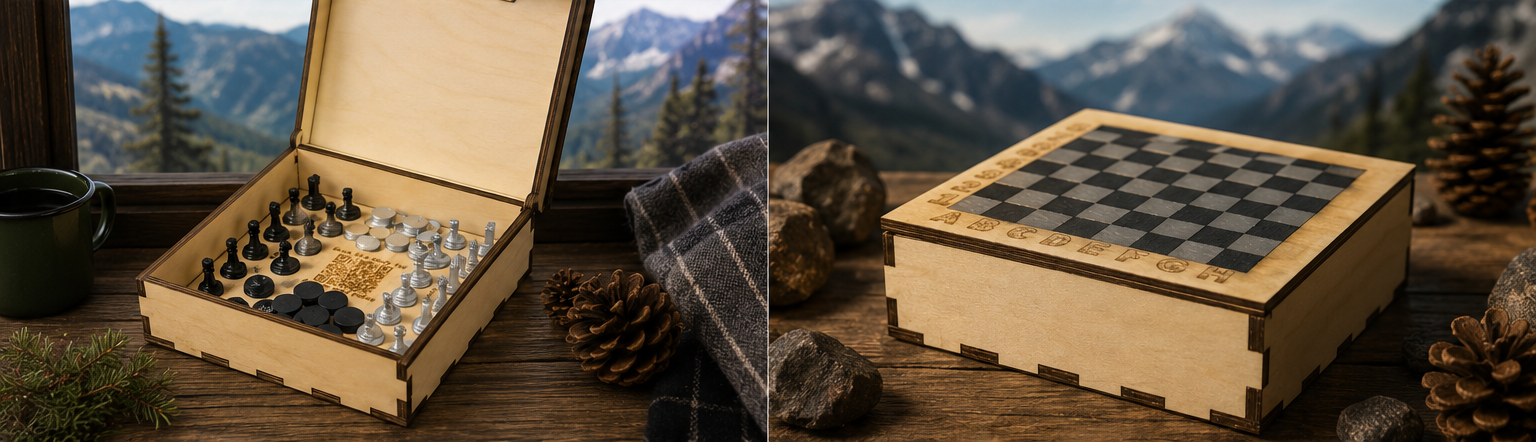
THE CHECKMATE DUO
Mini Chess & Checkers Travel Set
Two timeless strategy games in one handcrafted travel set—plus a bonus game you can play using the included checker pieces.
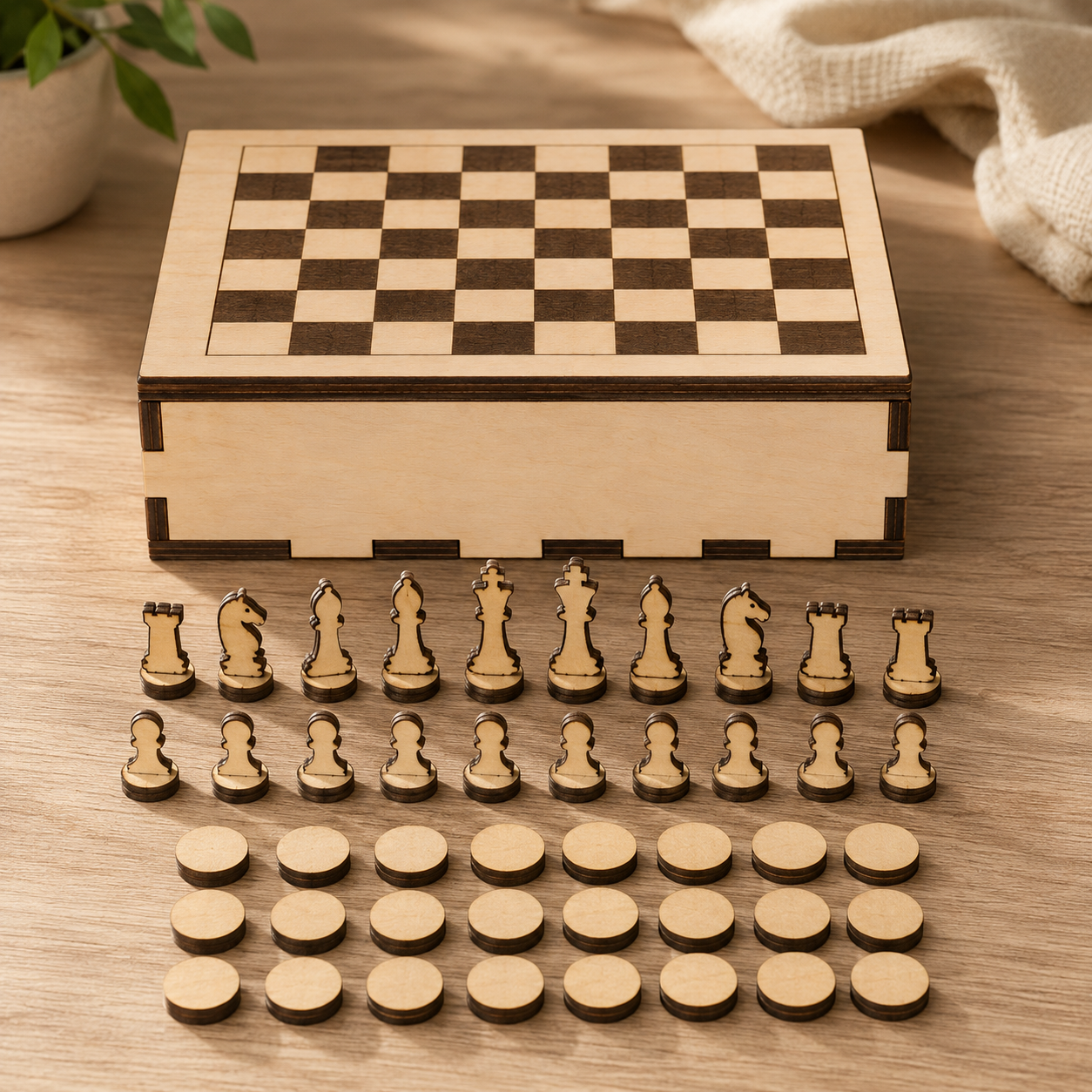
Rediscover timeless strategy games with our Handcrafted Mini Chess and Checkers Travel Set. Perfect for on-the-go enthusiasts.
Compact and portable, perfect for travel and small spaces
8x8 handcrafted board with built-in piece storage for easy organization
Includes a QR-linked digital game guide for strategic insights
Experience the joy of classic games wherever you are. This set brings family and friends together, creating lasting memories.
How to Play Chess
Chess is a two-player game played on an 8 × 8 board. Each player starts with 16 pieces.
The player with the light-colored pieces moves first. Players then take turns moving one piece at a time.
Goal of the Game
The goal is to checkmate your opponent’s king.
A king is in check when another piece is attacking it.
A king is in checkmate when it is under attack and there is no legal way to escape. The player who delivers checkmate wins.
You may never make a move that leaves your own king in check.
Setting Up the Board
Place the board so that each player has a light-colored square in the bottom-right corner.
The back row is arranged like this:
Rook – Knight – Bishop – Queen – King – Bishop – Knight – Rook
Place all eight pawns in the row directly in front.
Remember:
The queen starts on her matching color.
How the Pieces Move
King
The king moves one square in any direction.
The king cannot move onto a square that is being attacked.
Queen
The queen can move any number of open squares:
Forward
Backward
Sideways
Diagonally
Rook
The rook can move any number of open squares:
Forward
Backward
Sideways
Bishop
The bishop can move any number of open squares diagonally.
Knight
The knight moves in an L shape:
Two squares in one direction
Then one square to the side
The knight is the only piece that can jump over other pieces.
Pawn
Pawns move forward but capture diagonally.
A pawn may:
Move forward one square.
Move forward two squares on its first move.
Capture an opponent’s piece one square diagonally forward.
Pawns cannot move backward.
Capturing Pieces
You capture an opponent’s piece by moving onto the square it occupies.
The captured piece is then removed from the board.
You cannot move onto a square occupied by one of your own pieces.
Except for the knight, pieces cannot jump over other pieces.
Check and Checkmate
Check
When your king is in check, you must immediately:
Move the king to safety.
Capture the attacking piece.
Block the attack, when possible.
Checkmate
Checkmate happens when the king is in check and cannot escape.
The game ends immediately, and the player who delivered checkmate wins.
The king is never removed from the board.
Special Moves
Castling
Castling is a special move involving the king and one rook.
The king moves two squares toward the rook. The rook then moves to the other side of the king.
You may castle only when:
The king has not moved.
The rook has not moved.
No pieces are between them.
The king is not in check.
The king does not move through or land on an attacked square.
Pawn Promotion
When a pawn reaches the opposite end of the board, it must be replaced with a:
Queen
Rook
Bishop
Knight
Most players choose a queen.
En Passant
En passant is a special pawn capture.
When an opponent’s pawn moves forward two squares and lands beside your pawn, your pawn may capture it as though it moved only one square.
This move must be made immediately on your next turn.
How the Game Can End
Checkmate
A player wins by checkmating the opponent’s king.
Resignation
A player may choose to resign and end the game. The opponent wins.
Stalemate
The game is a draw when a player:
Is not in check.
Has no legal move.
Not Enough Pieces
The game is a draw when neither player has enough pieces to possibly checkmate the other king.
Draw by Agreement
Both players may agree to end the game in a draw.
Repeated Position
A draw may be claimed when the same position appears three times.
Fifty-Move Rule
A draw may be claimed after 50 moves by each player without a pawn move or capture.
Simple Playing Rules
Players take turns moving one piece.
Light-colored pieces move first.
You cannot move through another piece, except with a knight.
You cannot capture your own pieces.
You cannot make a move that leaves your king in check.
The first player to checkmate the opponent’s king wins.
How to Play Checkers
Checkers is a two-player game played on an 8 × 8 board. Each player begins with 12 pieces. Players take turns moving one piece at a time.
Goal of the Game
Win by doing either of the following:
Capture all your opponent’s pieces.
Block your opponent so none of their pieces can move.
Setting Up the Board
Place the board so that each player has a light-colored square in the bottom-right corner.
Each player places 12 pieces on the dark squares in the three rows closest to them. There should be four pieces in each row.
The player with the darker-colored pieces moves first.
Moving Your Pieces
Regular pieces move:
One square at a time
Diagonally forward
Only onto empty dark squares
Regular pieces cannot move backward.
Players take turns moving one piece unless a jump allows that piece to continue moving.
Capturing an Opponent’s Piece
You capture a piece by jumping over it.
A jump can be made when:
An opponent’s piece is diagonally beside your piece.
The square directly behind that piece is empty.
Move your piece over the opponent’s piece and land on the empty square. Remove the piece you jumped from the board.
If a jump is available, you must take it.
Multiple Jumps
After making a jump, check whether the same piece can jump again.
When another jump is available, continue jumping with that piece during the same turn. This is called a multiple jump or double jump.
You must continue until that piece has no more available jumps.
When more than one jumping path is available, you may choose which path to take.
Becoming a King
When a regular piece reaches the last row on your opponent’s side of the board, it becomes a king.
Place another checker on top of it or turn it over to show that it has been crowned.
A king may move and jump diagonally:
Forward
Backward
Kings still move only one square at a time unless they are jumping.
Your turn ends when your piece first becomes a king. It may begin moving backward on your next turn.
Winning the Game
You win when:
All your opponent’s pieces have been captured, or
Your opponent still has pieces but cannot make a legal move.
Quick Rules to Remember
Play only on the dark squares.
Regular pieces move diagonally forward.
Kings move diagonally forward or backward.
Move one square unless you are jumping.
Jump over an opponent’s piece to capture it.
You must jump when a jump is available.
Continue jumping when the same piece can capture again.
Reach the opposite side to become a king.
Capture or block all your opponent’s pieces to win.